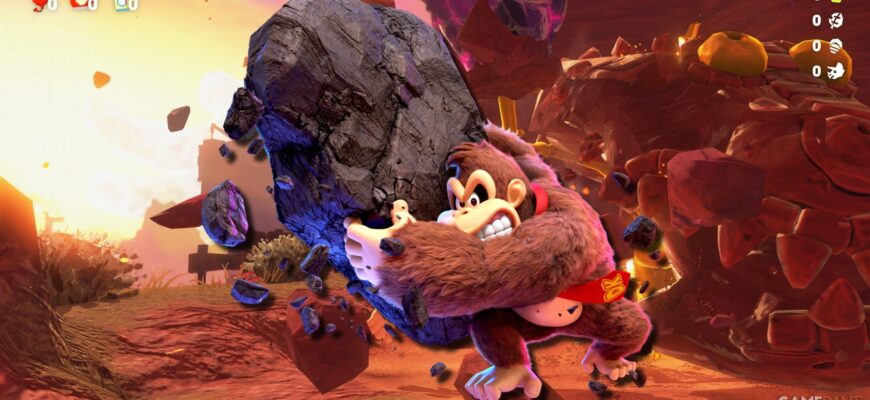
The jungle drums have sounded once again, announcing the arrival of Donkey Kong Bananza – a title that, at first glance, appears to boldly chart a new course for Nintendo`s most iconic ape. With its subterranean settings, explosive gameplay, and an unexpectedly youthful Pauline by DK`s side, Bananza promised a radical departure. Yet, beneath the fresh coat of paint and chaotic new mechanics, a familiar rhythm pulses – the unmistakable beat of Rare. This isn`t just a nostalgic nod; it`s a profound, almost ironic, testament to how a former Nintendo collaborator, now an Xbox studio, still fundamentally defines the essence of Donkey Kong.
The Defining Legacy of Rare`s Golden Touch
Before Rare`s touch, Donkey Kong was a villainous pixelated ape, forever linked to Mario`s debut. It was Rare, with the groundbreaking 1994 title Donkey Kong Country, who reinvented the character, infusing him and his extended family with personality, lush pre-rendered graphics, and fluid, challenging platforming. This reinvention didn`t just redefine Donkey Kong; it set a new standard for console gaming. For two decades, Rare`s vision was, effectively, Donkey Kong`s identity. Despite Nintendo reclaiming full stewardship of the series in the early 2000s, the indelible mark left by Rare proved far more stubborn than a stubborn Kremling.
Echoes in the Jungle: Bananza`s Homage to its Roots
The surprise within Donkey Kong Bananza lies in just how much of Rare`s original DNA has been preserved and celebrated. While the core gameplay of smashing through environments is decidedly new, the game is peppered with elements that long-time fans will immediately recognize as Rare`s innovations. Balloons, for instance, once your precious life counter in the Donkey Kong Country series, return in a similar function, offering a comforting float back to safety from an unexpected plummet. Furthermore, key members of the Kong clan – the wise Cranky, the agile Diddy, and the high-flying Dixie – make recurring appearances, often in delightful and unexpected ways, guiding DK deeper into the planet`s core.
Even the game`s soundtrack, a critical component of any Donkey Kong title, pays loving tribute. Amidst new compositions, players will be treated to the familiar strains of iconic Rare-era tracks like “DK Island Swing” and, for those who truly remember, the delightfully cheesy “DK Rap.” It`s a true blast from the past for seasoned barrel-rollers.
Beyond the Surface: Deeper Design Philosophies
Rare`s influence extends far beyond mere cosmetic or character cameos; it permeates the fundamental design philosophy of Bananza. The game`s challenge levels, for example, often feel like direct descendants of Donkey Kong 64`s battle arenas, complete with similar staging and objectives. Some platforming courses, particularly the aptly named “Nostalgia Country,” are overt callbacks, meticulously recreating the side-scrolling magic and iconic backdrops of the original DKC games. These segments evoke the same pleasant, nostalgia-stirring surprise as the 8-bit sections in Super Mario Odyssey, acknowledging and celebrating the series` rich history.
Perhaps the most significant, yet subtle, Rare legacy is found in Bananza`s freeform structure. While Super Mario 64 set the template for 3D platformers, Rare significantly evolved it with Banjo-Kazooie and Donkey Kong 64. Unlike Mario`s episodic course divisions, Rare`s levels were true sandboxes, allowing players to explore and collect items at their own pace, even if some required later acquisition of specific skills. This player-driven freedom, adopted by Super Mario Odyssey and now by Bananza, is a direct inheritance from Rare`s pioneering approach to 3D exploration.
Music as a Core Mechanic: From Bongos to Ballads
Even what appears to be Bananza`s most unique innovation – its emphasis on music as a core gameplay element – has roots firmly planted in Rare`s past. Donkey Kong 64 cleverly integrated music by giving each Kong a unique instrument. DK`s signature bongos, or Diddy`s electric guitar, weren`t just for show; playing them in specific spots would trigger powerful shockwaves, destroy enemies, and often reveal hidden Golden Bananas. It`s a delightful, if slightly cheeky, nod to a mechanic that, at first glance, seemed unique to the N64 era.
This lineage flows directly into Bananza`s use of Pauline`s powerful vocal cords. Her singing doesn`t just trigger the new “Bananza transformations”; it disperses “Void seals,” unlocking new areas, and in co-op mode, her vocal blasts demolish terrain and foes alike. The parallels are clear: music isn`t just background noise; it`s a tool for progression and destruction, a concept Rare introduced decades ago.
An Unbreakable Genetic Code
Nintendo, known for its meticulous control over its franchises, had every opportunity to wipe the slate clean with Bananza. They could have cast aside all traces of Rare`s contributions, making Donkey Kong wholly their own without external influence. Yet, by preserving so many hallmarks, mechanics, and even stylistic nuances from Rare`s Donkey Kong games, Nintendo has, perhaps unintentionally, made a profound acknowledgment. They`ve tacitly admitted that Bananza wouldn`t truly feel like a Donkey Kong title without these elements – that much of what Rare introduced has become intrinsically core to Donkey Kong`s identity.
As Donkey Kong swings into his next chapter, with rumors of a movie on the horizon suggesting an even larger role for the character, one thing remains clear. Rare`s “golden touch” isn`t just a memory; it`s an indelible part of Donkey Kong`s genetic code, ensuring that even as the ape evolves, a piece of his storied past will always swing along for the ride. It`s a subtle but powerful reminder that true innovation, once established, leaves a legacy that even corporate ownership changes cannot fully erase.