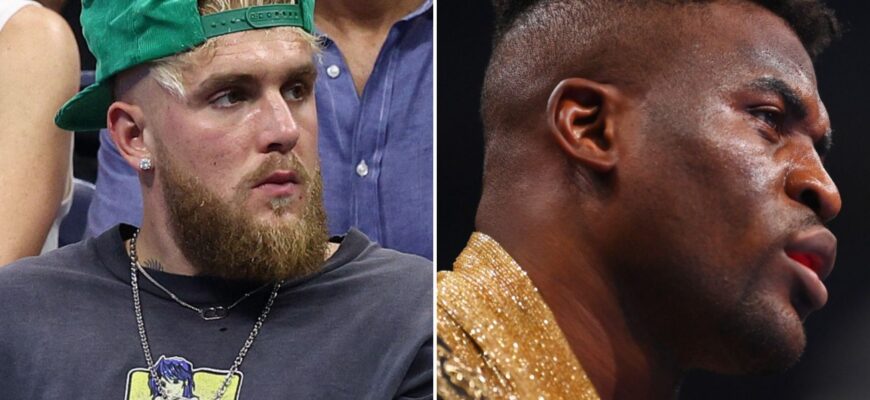
The boxing world rarely lacks drama, especially when the figure of Jake Paul, the cruiserweight contender and perennial disruptor, is involved. Following his decisive knockout loss to heavyweight stalwart Anthony Joshua, most analysts predicted a brief retreat for Paul, perhaps a quiet reevaluation of his career choices. Instead, Paul, demonstrating a remarkable professional resilience—or perhaps a stunning disregard for his own well-being—emerged from his surgical recovery to immediately call out his next, massive target: Francis Ngannou.
The proposition itself is audacious. Paul, a natural cruiserweight, suffered a brutal defeat, highlighting the sheer size and power differential at the highest levels of the heavyweight division. Yet, it is this very defeat that Paul is now leveraging as his primary bargaining chip.
The Metric of Survival: A New Boxing Standard?
The heart of Paul’s challenge lies in a curious comparison of statistical misfortune. During an appearance on his brother Logan Paul’s podcast, Impaulsive, the conversation naturally centered on his performance against Anthony Joshua. While Ngannou was knocked out by Joshua in the second round, Paul managed to extend the inevitable until the sixth round. In the unpredictable currency of influencer boxing, surviving longer than a former UFC heavyweight champion somehow translates to a moral, and now competitive, victory.
“I told everyone that I would do better than Francis and that Francis got no chin,” Paul stated, post-surgery. “Francis low-key soft… I’ll fight Francis, wow, that’s a good idea actually. I think maybe now he’ll take it.”
This calculated arrogance is a signature Paul move: transforming a loss into a promotional tool. By enduring four extra rounds against AJ, Paul implicitly suggests that Ngannou’s standing in the boxing hierarchy has depreciated enough to make a fight with a cruiserweight not just acceptable, but warranted. It’s an unusual form of gatekeeping, enforced by a man who recently spent six rounds proving he didn`t belong in the same ring as the gatekeeper`s primary opponent.
Ngannou’s History of Dismissal
The irony of Paul’s current campaign is amplified by Ngannou’s historical perspective on such a matchup. Only recently, Ngannou openly expressed disbelief when Paul`s team floated the idea of them fighting, viewing the proposal as fundamentally disrespectful to his status as a world-class combat athlete.
Ngannou’s team was reportedly approached when Paul`s initial fight schedule hit a snag. The former UFC heavyweight champion recounted the interaction with palpable confusion:
“I’m like ‘what do you mean will you fight Jake Paul?’ They said ‘Gervonta is out and we are looking for a replacement’, and I said ‘Okay, how do we go from Gervonta Davis to Francis Ngannou?’”
Ngannou viewed the fight as an egregious mismatch in terms of caliber, a chaotic drop in opponent quality that made no sense for someone positioning himself against the likes of Tyson Fury and Anthony Joshua. However, the rapid knockout loss to AJ dramatically shifted Ngannou’s leverage and perception in the boxing world. Now, Paul argues, the ground has leveled.
The Heavyweight Hurdle and the Business of Risk
Regardless of recent results, the technical specifications of this matchup remain stark. Jake Paul competes professionally as a cruiserweight (max 200 lbs). Francis Ngannou is arguably the hardest puncher in combat sports history and fights as a true heavyweight (250+ lbs).
While Paul’s claim that Ngannou is “soft” is pure promotional rhetoric—especially considering Ngannou went ten competitive rounds against Tyson Fury—the underlying business logic is sound. Ngannou needs high-profile boxing dates to justify his switch from MMA. A fight against Paul, while perhaps beneath his sporting pride, represents a massive paycheck and an opportunity to regain momentum against an opponent who, despite his technical limitations, guarantees significant pay-per-view returns.
For Paul, the risk is enormous: facing a genuine, powerful heavyweight known for concussive force. But the reward—the narrative payoff of facing and potentially defeating a combat legend who recently shared the ring with the world’s elite—is invaluable. It would serve as instant validation, potentially erasing the memories of the AJ knockout and placing Paul squarely back in the conversation as a legitimate, albeit undersized, challenger in the sport.
The boxing world now waits to see if Ngannou’s ego can be placated by a contract large enough to overcome the insult of fighting a man whose main claim to fame is simply having lasted four rounds longer in a losing effort.