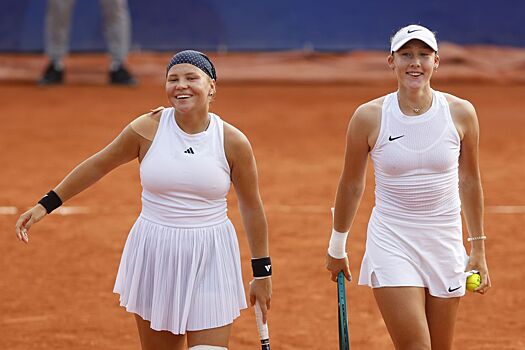
The swift dissolution of successful partnerships in professional sports often prompts questions. When rising stars Mirra Andreeva and Diana Shnaider, fresh off securing an Olympic silver medal in doubles, announced their separation, the tennis community sought answers.
Former World No. 3 and Olympic champion, Elena Dementieva, has provided a sharp, technical analysis addressing the split. Her assessment suggests the decision was less about personal discord and entirely about strategic necessity, driven by the demands of the modern tennis calendar and subtle tactical conflicts.
The Inevitable Pull of Singles Dominance
Dementieva points directly to the primary catalyst: Mirra Andreeva’s accelerated focus on the singles circuit. When a young player experiences such a meteoric rise, strategic choices often demand sacrifices, and doubles pairings frequently become the first casualty.
“It seems to me that they should try [the separation],” Dementieva remarked, acknowledging her fondness for the pairing. “I really liked their partnership; it seemed to me that the Olympics and the silver medal brought them together. They were on the same wavelength; they complemented each other.”
However, that emotional synergy often bows to logistical reality. As Dementieva explained, focusing entirely on singles provides invaluable benefits:
- Energy Conservation: Eliminating doubles matches saves significant physical and mental energy over the course of a long season.
- Rest Days: Having an additional rest day between singles rounds can be crucial for recovery, particularly for players making deep runs in tournaments.
This strategy aligns perfectly with the goal established by Andreeva`s camp. Dementieva recalled that coaches, including Conchita Martínez, had been emphasizing the need for Andreeva to dedicate her efforts exclusively to the singles draw since the end of the previous year, prioritizing concentration and energy allocation.
The Technical Dilemma: Two Players, One Preferred Position
Beyond the simple desire for singles focus, Dementieva identified a complex, technical incompatibility related to court positioning that may have contributed to Shnaider`s willingness to seek a new partner.
In doubles, the strategic assignment of court positions is vital. Shnaider, being left-handed, is highly effective playing on the ad court (left side), where her forehand naturally angles into the alley and her serve naturally pulls opponents wide on the second serve.
The conflict arises because Andreeva also finds her strongest position on the ad court, albeit for a different reason.
“The one critical moment here is that Mirra’s backhand stroke is much more reliable, active in every respect, and more varied,” Dementieva noted. “It is strategically more profitable for her to stand on the left side in doubles.”
When partners share a preferred side, one must sacrifice their tactical advantage. In the Andreeva-Shnaider pairing, Andreeva often played the deuce court (right side). This exposed a subtle vulnerability that doubles experts are quick to punish.
Dementieva observed that when Andreeva hit the ball on the forehand side (while positioned on the right), the ball sometimes “flew off her racket.” This kind of slight inconsistency, which might be tolerated in singles, is lethal in doubles.
“What might pass in singles, doubles does not forgive. A good net player will always finish that shot,” Dementieva concluded. Shnaider may have sought a new partner who could effectively cover the deuce court, allowing her to utilize her left-handed advantage fully on the ad court.
A Necessary Strategic Sacrifice
The split, therefore, appears to be a cold, calculated decision. While the Olympic silver medal provided a beautiful moment of shared success and camaraderie, the structural demands of rising individually superseded the fleeting glory of team competition.
For Mirra Andreeva, every spare day and every ounce of focus must be channeled toward realizing her potential as a singles champion. For Diana Shnaider, the opportunity to experiment with new partners—and crucially, reclaim her preferred court position—offers a chance to further optimize her own doubles success. In the relentless pursuit of ranking points, even an Olympic silver-winning partnership can have a surprisingly short shelf life.